
Non-stick Nuisance: Medical Monitoring for PFAS
A one-hour Continuing Medical Education (CME) course prepares clinicians to address PFAS
Available for AMA PRA Category 1 CreditTM
This course aims to educate healthcare providers in addressing patient concerns about PFAS exposures. The presentations discuss individual risk factors, screening recommendations, PFAS exposure assessment, prevention and follow-up approaches, blood testing, and additional resources for clinicians. In addition, the course features real-life stories of people affected by PFAS contamination and how they navigated the health risks of PFAS with their clinicians. The presentation promotes competencies for understanding and preventing PFAS exposures and related diseases.
How to receive free CME credit
- Go to the Michigan State University (MSU) CME page (link)
- Log in or create a free account
- Answer pre-course questions
- Watch the video
- Answer post-course questions
Please note: the video player on MSU’s CME page disables rewinding or fast forwarding. If you want to go back and revisit certain sections, you can re-watch the video on YouTube.
Help us improve clinician education
In 2026, researchers from our PFAS-REACH team launched a new research project funded by the Robert Wood Johnson Foundation. The project aims to improve and disseminate educational resources for doctors and nurses about PFAS health effects, blood testing, and medical monitoring.
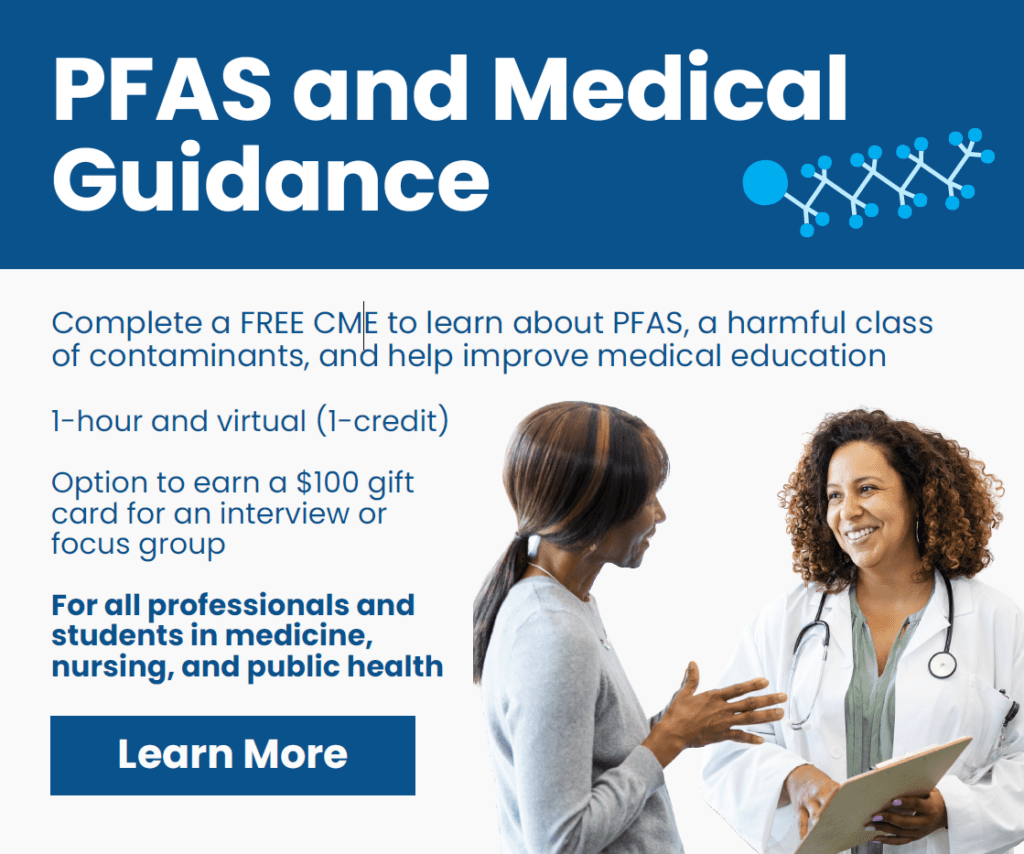
For this project, we are hosting focus groups and interviews with healthcare providers and other practitioners, as well as students in medicine, nursing, and public health. We want to hear your perspectives and experiences in addressing PFAS in clinical settings. To participate in an interview or focus group, you can sign up after completing the CME course or email us directly at PFAS-REACH@silentspring.org.
In addition, PFAS-REACH is offering Grand Rounds presentations about PFAS for hospitals and other institutions. To inquire about scheduling a presentation with our research team, contact PFAS-REACH@silentspring.org.
If you watched the CME video on YouTube
Even if you don’t complete the CME course for credit, we’d still like your feedback. Please complete our brief 2-minute survey.
Stay connected
Join a listserv to receive updates about PFAS in clinical practice by sending an email to listserv@list.msu.edu. In the body of the email, put “subscribe pfasinpatientcare your name,” replacing ‘your name’ with your actual name and credentials. For example, “subscribe pfasinpatientcare Alice Hamilton, MD, MPH.”
For more information
Our Non-stick Nuisance Handout provides additional resources for clinicians and public health practitioners.