
Removing PFAS from drinking water
Learn about different technologies used by water systems to keep PFAS out of drinking water
With the 2024 announcement of the first federal drinking water standards for PFAS, public water systems are now required to monitor for these chemicals and take steps to meet the new limits [1]. Many systems across the U.S. have already begun installing treatment technologies to remove PFAS. Because each option has its own strengths and limitations, understanding how they work—and what to consider—is key to choosing the right approach.
Granular activated carbon (GAC)
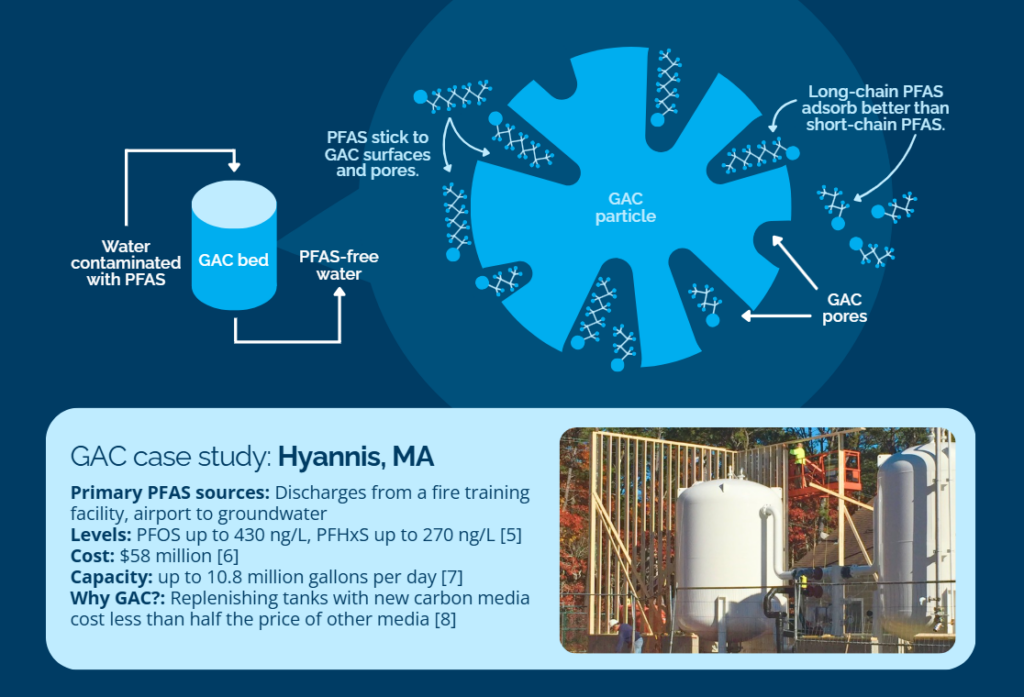
A GAC tank is filled with carbon particles that have tiny pores on their surfaces. When water contaminated with PFAS passes through the tank, PFAS stick to the surface of GAC particles, a process called adsorption. Two tanks are usually used in series: a “lead” tank that removes PFAS from water first, and a “lag” tank that acts as a backup in case any PFAS pass through the lead tank [2-4].
Watch an interview about Hyannis’s PFAS treatment system here.
Anion exchange resin (AER)
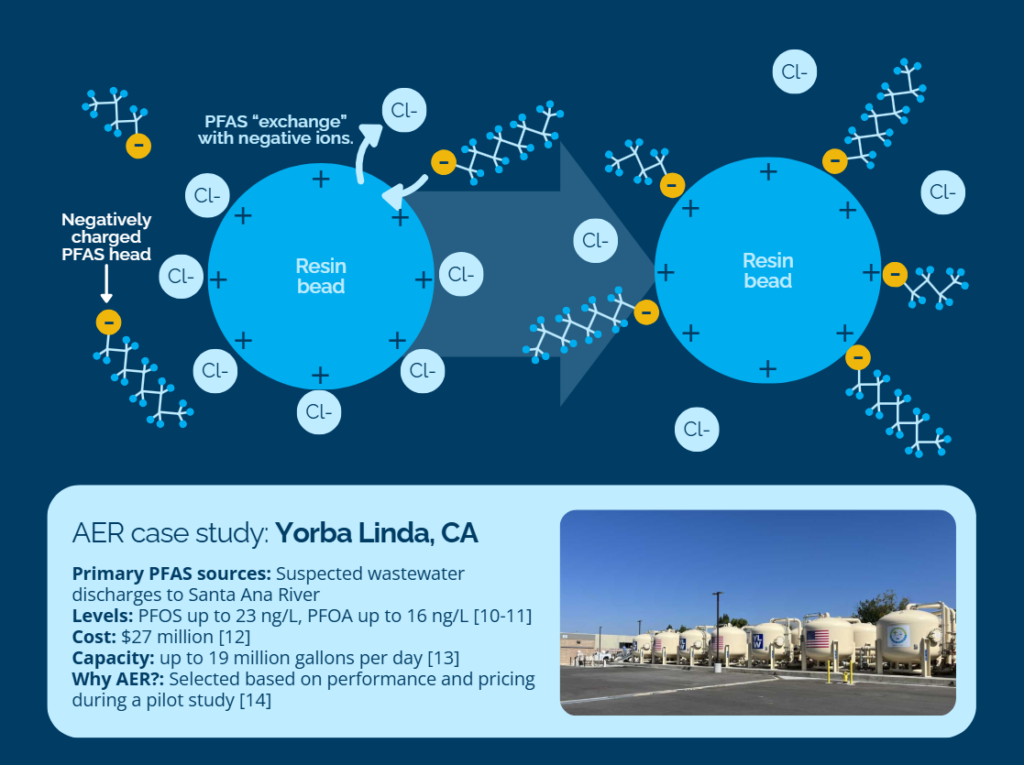
AERs are a type of ion exchange resin. They are made up of positively-charged polymer beads with negatively-charged ions (anions) covering the beads’ surfaces. When PFAS-containing water moves through an AER bed, negatively-charged PFAS will “exchange” with those ions and stick to the beads [2-4, 9].
Reverse osmosis (RO) / Nanofiltration (NF)
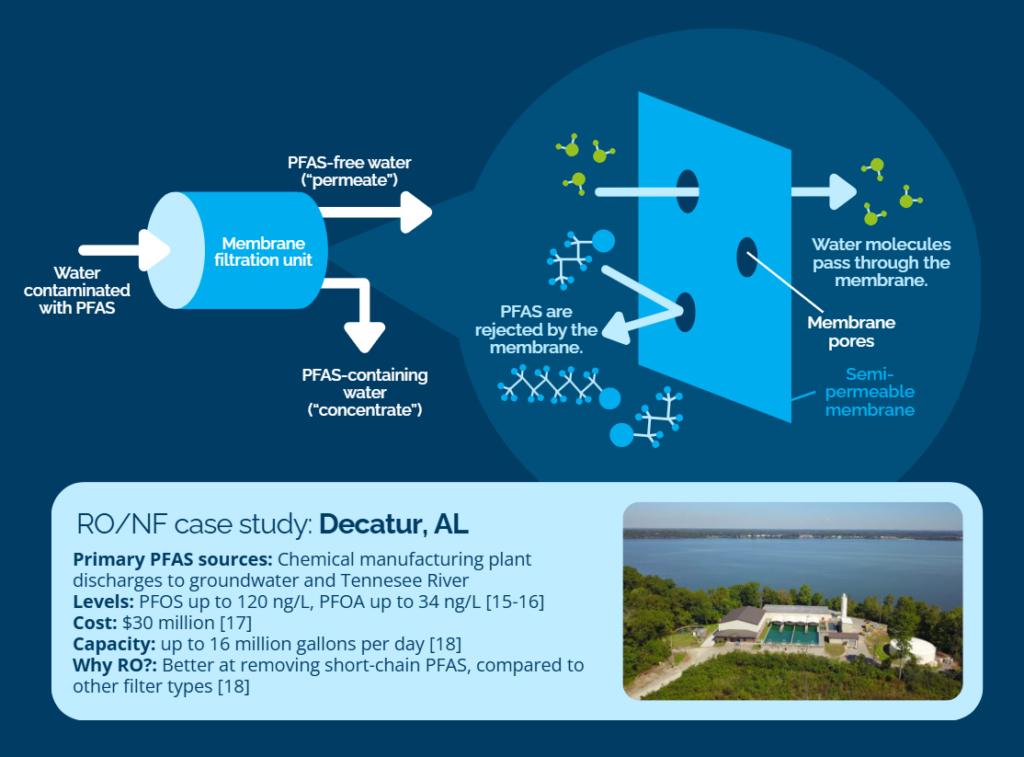
RO and NF both send pressurized water through a membrane. The membrane’s pores are small enough to block PFAS while allowing water to pass through. In general, RO filters have smaller pores than NF and require a higher water pressure [2-4].
Comparing technologies
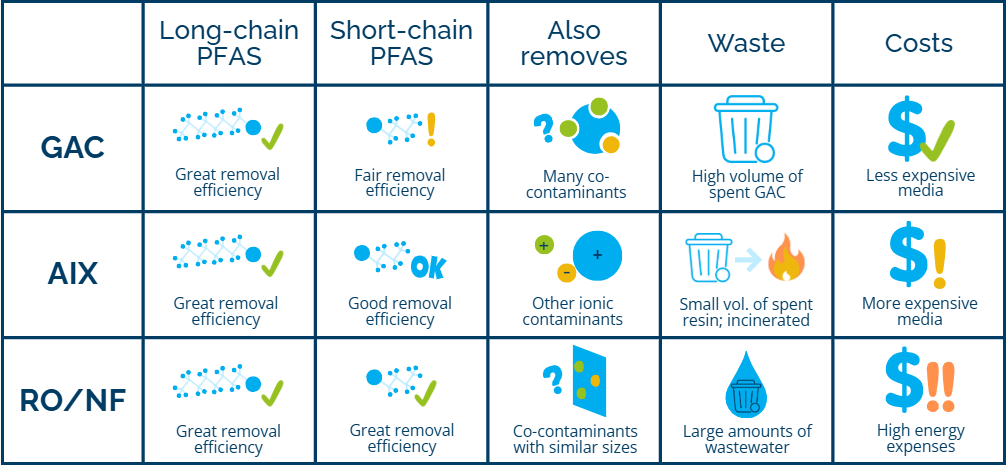
Each of the technologies above—GAC, AER, and RO/NF—have distinct advantages and disadvantages. All are widely used by public water systems to remove PFAS from water. Specific technologies may work best depending on cost, water chemistry, and the types of PFAS present [2-4, 19].
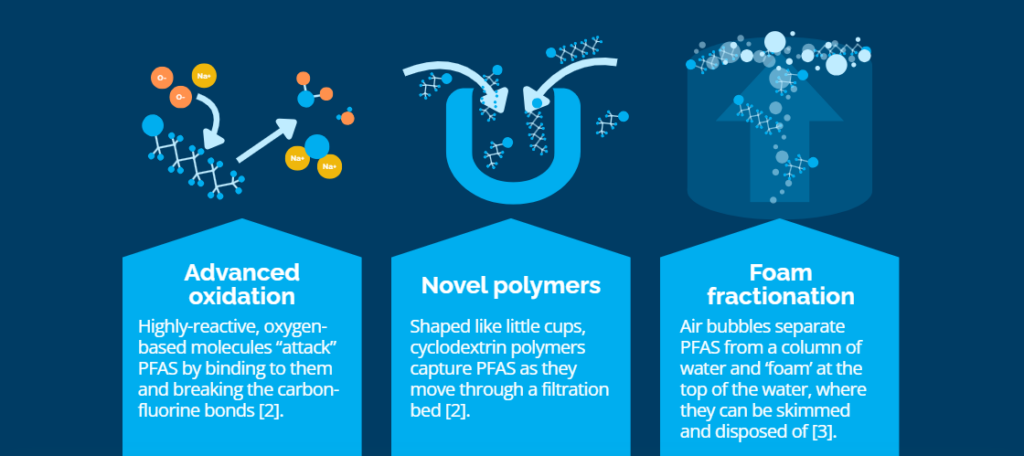
Other technologies
These technologies are still being researched. They’re sometimes used in “treatment trains” with more established filtration systems to address very high levels of PFAS.
References
- U.S. Environmental Protection Agency (2026). “Per- and Polyfluoroalkyl Substances (PFAS): Final PFAS National Primary Drinking Water Regulation.” https://www.epa.gov/sdwa/and-polyfluoroalkyl-substances-pfas
- Tshangana, C.S., Nhlengethwa, S.T., Glass, S. et al. (2025). “Technology status to treat PFAS-contaminated water and limiting factors for their effective full-scale application.” npj Clean Water, 8(41). https://doi.org/10.1038/s41545-025-00457-3
- Interstate Technology Regulatory Council (2026). “Treatment Technologies.” PFAS: Per- and Polyfluoroalkyl Substances. https://pfas-1.itrcweb.org/12-treatment-technologies/
- U.S. Environmental Protection Agency (2024). Best Available Technologies and Small System Compliance Technologies for Per- and Polyfluoroalkyl Substances (PFAS) in Drinking Water. https://www.epa.gov/system/files/documents/2024-04/2024-final-pfas-bat-ssct_final-508.pdf
- Heckel, E., DeVries, R.R., Knox, K.E., et al. (2026). “Residential history and drinking water type as predictors of serum PFAS in communities with a history of contaminated drinking water.” J Expo Sci Environ Epidemiol. https://doi.org/10.1038/s41370-026-00937-9
- Keijser, H. (2021, February 3). Let’s talk about PFAS: How can I tell if PFAS are in my drinking water? (webinar). URI STEEP Superfund Research Program. https://web.uri.edu/steep/lets-talk-about-pfas-new-monthly-speaker-series-to-help-communities-address-contamination-and-reduce-exposures/
- Massachusetts Executive Office of Energy and Environmental Affairs (2024, November 1). Certificate of the Secretary of Energy and Environmental Affairs on the expanded environmental notification form and proposed environmental impact report. Cape Cod Commission. https://resources.capecodcommission.org/resource-library/a00d92743422/2024-12-16-hyannisport-water-treatment-eenf-certificate/
- Keijser, H. (2026). “Treating PFAS in drinking water in Hyannis, Massachusetts” (interview). PFAS Exchange. Silent Spring Institute. https://pfas-exchange.org/resource-hub/treating-pfas-in-drinking-water-in-hyannis-massachusetts/
- U.S. Environmental Protection Agency (2018). “Reducing PFAS in drinking water with treatment technologies.” https://www.epa.gov/sciencematters/reducing-pfas-drinking-water-treatment-technologies
- Huang, P. (2024, September 12). “How a California county got PFAS out of its drinking water.” National Public Radio. https://www.npr.org/sections/shots-health-news/2024/09/12/g-s1-22291/pfas-drinking-water-filter
- Pannu, M., Plumlee, M. (2021). PFAS Phase I pilot-scale treatment study: Final report. Orange County Water District. https://www.ocwd.com/wp-content/uploads/2021-03-24_ocwd-pfas-pilot-i_finalreport.pdf
- deSilva, V., Deshmukh, D. (2025). “The cost to remove PFAS: A review of U.S. water treatment plants.” J AWWA, 117(4), 54-63, https://doi.org/10.1002/awwa.2436
- Yorba Linda Water District (2026). “J. Wayne Miller, Ph.D Water Treatment Plant.” https://www.ylwd.com/services/your-water/water-quality/pfas-water-treatment-plant/
- Olsen, C. (2026). “Leading Orange County’s PFAS response.” American Infrastructure. https://www.americaninfrastructuremag.com/leading-orange-countys-pfas-response/
- WHNT News 19 (2019, April 4). “Sources: 3M reaches settlement with West Morgan-East Lawrence Water Authority in drinking water contamination case.” Nexstar Media. https://whnt.com/news/3m-settles-with-west-morgan-east-lawrence-water-authority-in-drinking-water-contamination-case/
- Alabama Department of Environmental Management (2022). All PFAS results > MRL. https://adem.alabama.gov/sites/default/files/legacyfiles/programs/water/drinkingwater/files/AllPFASResults.pdf
- Scarpino, M. (2021, November 18). “West Morgan East Lawrence Water Authority opens new facility for clean water.” WAFF. Gray Local Media. https://www.waff.com/2021/11/19/west-morgan-east-lawrence-water-authority-opens-new-facility-clean-water/
- Wetzel, M. (2021, August 11). “Reverse osmosis filtration facility near completion.” The Moulton Advertiser. https://www.moultonadvertiser.com/news/article_dd221c14-fabf-11eb-801f-c3b7ff0b4dc4.html
- CDM Smith (2026). “Comparing common PFAS treatment options.” https://www.cdmsmith.com/resources/insights/comparing-common-pfas-treatment-options